



I get asked some version of this question almost every week. Usually from a founder who’s been posting on and off for a year, has a decent blog nobody reads, and can’t quite explain what any of it is supposed to be doing for the business. My answer is always the same. You don’t have a content problem. You have a strategy problem.
Over the past 7 years, I’ve worked on 570+ content projects across industries that had almost nothing in common: real estate, healthcare, SaaS, hospitality, eCommerce. And the thing that separated the brands whose content actually worked from the ones quietly wasting money was never talent or budget. It was whether there was a real plan behind the words.
So let’s actually break this down. What content strategy means, why it matters more than most businesses realize, particularly in 2026 and years forward, and how to build one without needing a marketing degree to understand it.
What Is Content Strategy?
Let’s start simple. If someone asked me what is content strategy in one sentence, I’d say this: it’s the plan that decides what content you create, why you’re creating it, who it’s for, and how it connects back to your business goals.
Notice what’s missing from that definition. Writing. Publishing. Posting. Those are execution, not strategy. It sits above all of that; it’s the thinking that happens before a single word gets written. Which audience are you actually talking to? What do they need to know before they trust you? What format makes sense for that message? And how will you know if it worked?
Most businesses skip straight to execution. They open a blank document and start typing because someone said: “We need more content.” That’s backwards. Without a strategy, even genuinely good writing tends to land nowhere, because it was never aimed at anything specific in the first place.
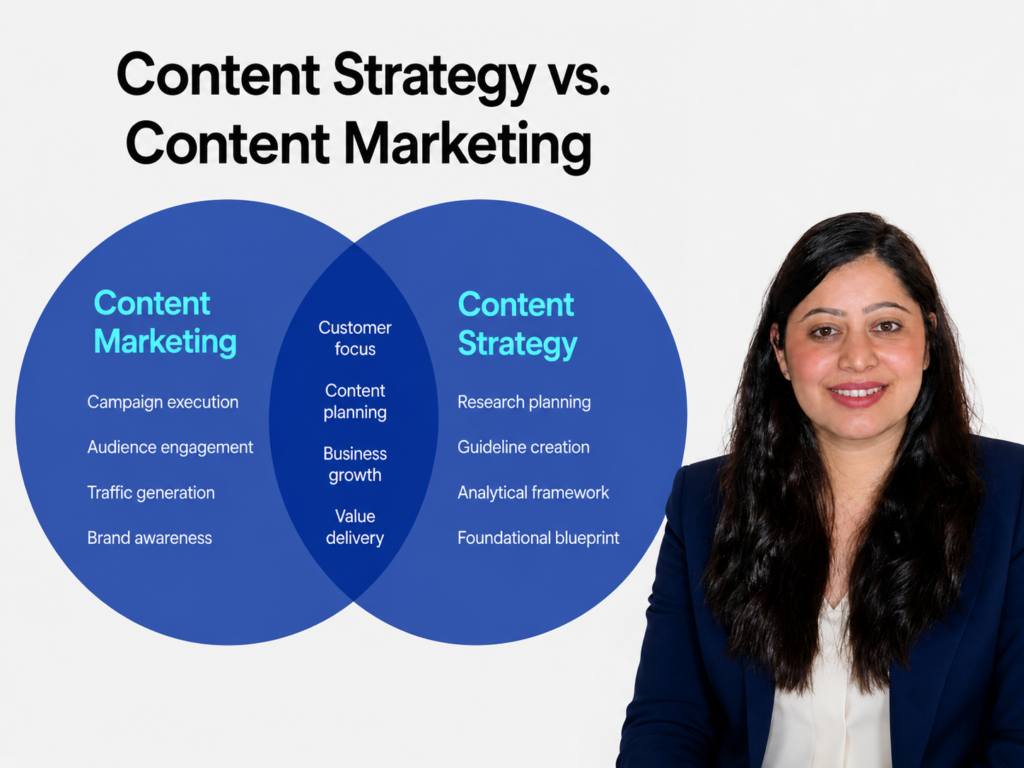
Content Strategy vs Content Marketing: What’s the Difference?
This one trips people up constantly, and honestly, I don’t blame them. The terms get used all the time interchangeably, even by people who should know better.
Here’s the distinction I use with clients. The strategy is the plan. Marketing is the execution of that plan. One answers what and why; the other, the writing, design, and distribution that come with it, answers how and when.
Think of it like building a house. The strategy is the blueprint; it decides the layout, the number of rooms, where the plumbing goes. Content marketing is the actual construction, the bricklaying, the painting, the finishing touches people see and interact with. You genuinely cannot do one well without the other. Plenty of businesses jump straight to construction without a blueprint, and it shows. Rooms that don’t connect. Doors leading nowhere. Content that’s technically published but doesn’t add up to anything coherent.
Why Content Strategy Actually Matters
Here’s where I’ll bring in some numbers, because I don’t want this to sound like an opinion. Recent industry data backs this up. Organizations with a documented content strategy have a 3.5 times higher rate of success rate compared to those without one, according to widely cited research. Businesses that maintain an active, strategic blog also tend to see significantly more monthly traffic than those that don’t.
That gap isn’t small, and it isn’t random. When content decisions are guided by a strategy, every blog post, landing page, and social caption is pulling in the same direction. When there’s no strategy, you get content that exists, technically, but doesn’t build on anything. No compounding effect. No clear audience takeaway. Just activity, mistaken for progress.
I’ve seen this play out firsthand more times than I can count. A client comes to me publishing three blog posts a week with barely any traffic to show for it. We pause, build an actual plan around search intent and their real audience, and within a few months, the same amount of effort (sometimes less) starts producing actual results. Not magic. Just direction.
Elements of a Content Strategy: The Basics You Need
If you’re new to this, understanding the elements of a content strategy will save you a lot of wasted effort later. These are the building blocks I come back to on every single project, regardless of industry or budget.
Audience research. You cannot write for “everyone.” Understanding who you’re actually talking to, their questions, their hesitations, their search behavior, is the foundation everything else sits on.
Goals and KPIs. What is this content actually supposed to do? Drive traffic, build trust, generate leads, support sales conversations? Different goals need different content entirely.
Content pillars and topics. The handful of core themes your content will consistently cover, tied directly to what your audience cares about and what your business wants to be known for.
Formats and channels. Blog posts, videos, social content, email, landing pages. Not every format suits every message, and not every channel suits every audience.
Editorial planning. A realistic calendar for what gets published, when, and by whom, so content stays consistent instead of happening in unpredictable bursts.
Measurement. How you’ll actually track whether any of this worked, beyond just “we posted something.”
These are the content strategy basics. Skip any one of them, and the whole thing gets shakier.
Building a Content Strategy Framework
A content strategy framework is really just a repeatable structure you apply to organize all those elements above. I use a version of this with nearly every client, adjusted for their specific situation:
- Audit what content already exists and how it’s performing.
- Research the audience and their actual search intent.
- Define clear, measurable goals.
- Map content pillars and topic clusters around those goals.
- Plan the calendar and assign ownership.
- Create and publish, staying consistent with brand voice.
- Measure and refine, because no strategy is finished on day one.
Having a framework matters because none of this is a one-time document you write and forget. It’s a living system that gets revisited as your business, audience, and search landscape shift.
Creating a Content Strategy Plan: How to Actually Do It
Alright, here’s the part everyone actually wants. How do you turn all of this into a real content strategy plan you can act on this week?
Start with research, not writing. Before touching a single blog title, understand what your audience is searching for and why. Tools help here, but so does just reading the comments on your competitors’ content and noticing what questions keep coming up.
Next, get specific about goals. “More visibility” isn’t a goal; it’s a wish. “Rank for these 15 search terms within six months” is a goal you can actually plan around.
Then build your topic clusters. Pick 3 to 5 core themes relevant to your business, and map out supporting content underneath each one. This is where SEO and strategy start talking to each other properly; clusters help search engines understand your site’s authority on a topic, and they help readers find their way deeper into your content.
From there, build a realistic calendar. I always tell clients to plan for less than they think they can manage. Four genuinely good, well-researched pieces a month will outperform twelve rushed ones almost every time.
Finally, put a measurement habit in place. Monthly check-ins on traffic, rankings, and conversions, so the plan stays a living document instead of something written once and forgotten in a shared drive.
Final Thoughts
If there’s one thing I want you to take from this, it’s that a real strategy isn’t a fancy add-on for big companies with big budgets. It’s the difference between content that quietly builds something over time and content that just… exists. I’ve watched both versions play out enough times to know which one I’d rather help a business build.
If you’re staring at a content calendar that isn’t doing much, or you don’t have one at all yet, that’s usually the first honest place to start.
Frequently Asked Questions
What are the 5 pillars of content strategy?
Most frameworks converge on five: audience understanding, clear goals, consistent brand voice, strategic distribution, and measurement. Some versions swap in “content governance,” but these five cover the core of what keeps a strategy functional.
What are the 7 steps in creating a content strategy?
Audit existing content, research your audience, define goals, map topics and clusters, build an editorial calendar, create and publish, then measure and refine. It’s a cycle, not a straight line; step seven usually loops you back to step one.
What are the 5 C’s of content?
Clarity, consistency, credibility, creativity, and connection. Content that ranks and resonates tends to hit all five: clear enough to understand fast, consistent enough to build trust over time, credible enough to be believed, creative enough to stand out, and connected enough to feel relevant to the reader’s actual situation.
What are the 4 P’s of content?
Purpose, people, platform, and performance. Why you’re creating it, who it’s for, where it lives, and how you’ll know it worked. A simpler lens than the 5 C’s, but it covers the essentials for smaller teams just getting started.
How do you build a content strategy for a startup?
Start smaller than feels comfortable. Pick one or two audience segments, one or two core topics, and one primary channel. Startups rarely have the resources to do everything well, so a focused content strategy beats a scattered one every time. Revisit and expand once you see what’s actually working.
What is a content strategy in digital marketing?
In a digital marketing context, content strategy is the plan that guides every piece of content across your online presence, website, blog, social, and email, so it works together toward shared business goals instead of existing as disconnected, one-off efforts.